There is an argument that keeps coming back in marketing:
Should a business focus on performance marketing or brand building?
One side says, “Forget awareness. We need sales.”
The other says, “Stop chasing immediate conversions. We need to build a brand.”
Both sides have a point.
But treating them as opposing strategies can create a bigger problem.
Because businesses don’t have to choose between getting customers today and building a brand for tomorrow.
They need to understand how the two work together.
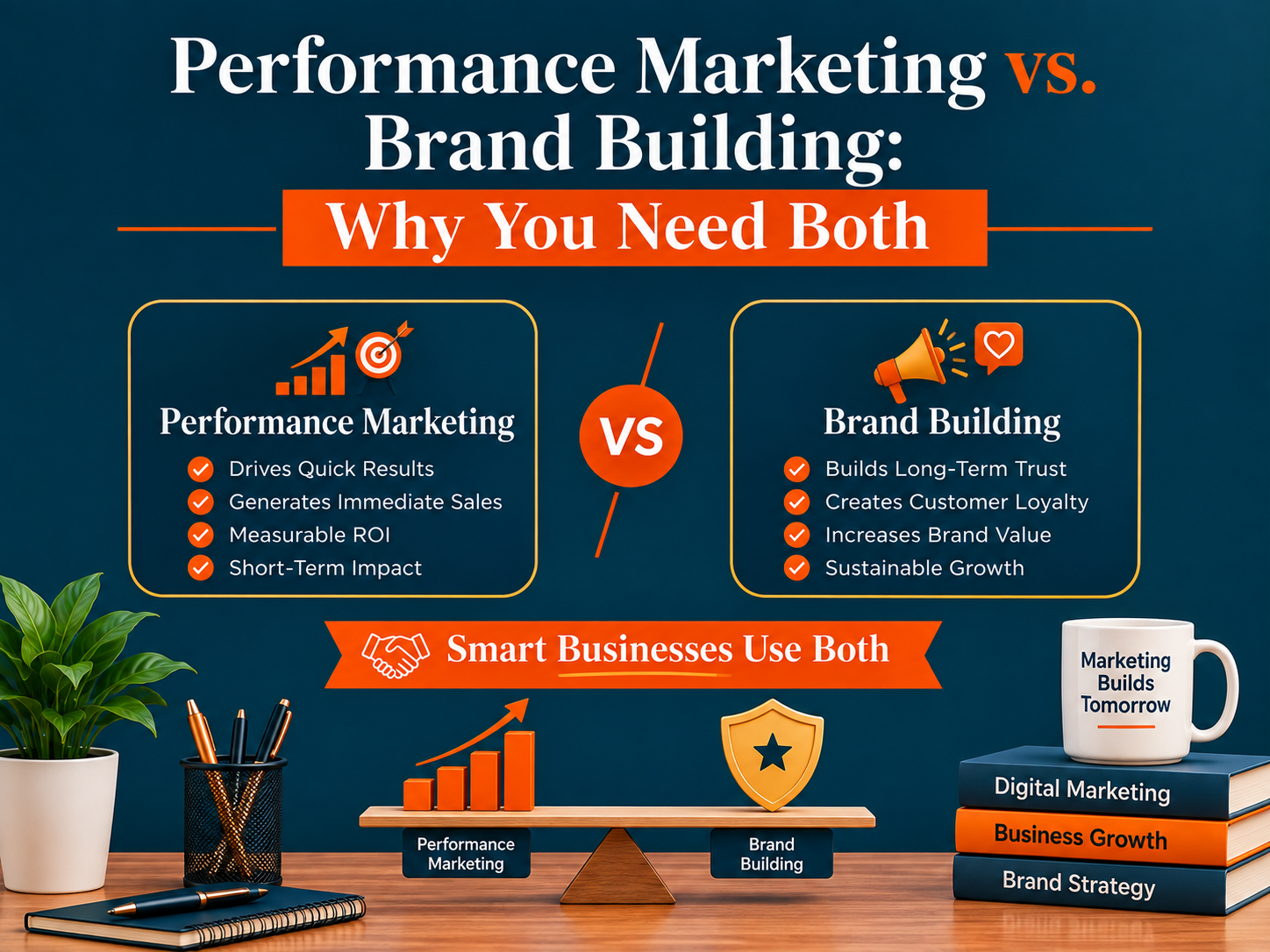
Performance marketing can help generate measurable demand and customers.
Brand building can make your business more recognizable, trusted, and preferred over time.
When they work together, marketing becomes much more powerful.
What Is Performance Marketing?
Performance marketing is focused on measurable actions and business outcomes.
Depending on the business, those actions could include:
- Purchases
- Leads
- App installs
- Bookings
- Sign-ups
- Sales
- Qualified inquiries
The goal is to understand what you’re spending and what you’re getting in return.
Common performance marketing channels include:
- Google Ads
- Meta Ads
- YouTube Ads
- Paid social
- Affiliate marketing
- Conversion-focused landing pages
- Retargeting
Performance marketing is particularly attractive to businesses because the results can often be tracked relatively quickly.
You can see impressions, clicks, conversions, acquisition costs, revenue, and other metrics.
But there’s a catch.
What you can measure quickly isn’t always the same thing as what creates long-term growth.
What Is Brand Building?
Brand building is the process of creating a distinctive and trusted perception of your business in the minds of customers.
It goes beyond your logo, colors, and website.
A brand is influenced by:
- What you stand for
- How you position yourself
- What people associate with you
- How recognizable you are
- How customers experience you
- What people say about you
- How consistently you communicate
- Why people choose you over alternatives
Brand building usually takes longer to show results than a performance campaign.
You may not be able to look at today’s Instagram post and say:
“This post generated exactly $4,287 in brand value.”
That’s not how brand building works.
Its impact often accumulates over time.
People see you repeatedly.
They remember you.
They become familiar with you.
They start trusting you.
Then, when they eventually need what you offer, you’re no longer a stranger.
You’re one of the options they already know.
Performance Marketing Gets the Click. Brand Can Help Earn the Choice.
This is where the two approaches start to make sense together.
Imagine someone needs a marketing agency.
They search Google and find three agencies.
All three offer similar services.
All three have similar pricing.
Which one do they choose?
The decision may come down to things that aren’t visible in a basic ad campaign.
Maybe they’ve seen one agency’s content before.
Maybe they recognize the founder.
Maybe they’ve heard someone mention the company.
Maybe the website feels more credible.
Maybe the brand communicates more clearly.
Maybe the company has built authority around a specific problem.
The advertising may have created the opportunity.
But the brand can influence the decision.
That’s why brand matters.
Why Performance Marketing Alone Can Become Expensive
Performance marketing is incredibly useful.
But if a business relies entirely on paid acquisition, it can create a difficult situation.
You need to keep paying to get attention.
Stop the campaigns, and your traffic may drop sharply.
This doesn’t mean paid advertising is bad.
It means a business should think beyond the immediate transaction.
If every customer has to be purchased again and again through advertising, your marketing system can become increasingly dependent on paid distribution.
A strong brand can help reduce that dependency over time by creating:
- Recognition
- Trust
- Direct demand
- Organic attention
- Repeat purchases
- Word of mouth
- Customer preference
The goal isn’t necessarily to stop advertising.
It’s to make your overall growth system stronger.
Why Brand Building Alone Can Also Be a Problem
The opposite extreme has its own problems.
Some businesses spend years “building the brand” without creating a reliable path to revenue.
They produce beautiful content.
They invest in visual identity.
They publish thought leadership.
They gain followers.
But sales remain unpredictable.
A brand needs a business behind it.
Awareness without conversion doesn’t pay the bills.
This is where performance marketing can provide discipline.
It forces businesses to ask:
What action do we want the customer to take?
What does it cost to acquire them?
Which audience converts?
Which offer works?
Which message produces results?
Brand building creates long-term value.
Performance marketing creates measurable feedback and action.
You need both.
The Problem With Chasing Only Short-Term Results
Let’s say an e-commerce business is optimizing every campaign for immediate purchases.
The marketing team discovers that discounts produce the highest conversion rate.
So they run more discounts.
Sales increase.
The business celebrates.
Then customers start waiting for the next discount.
Margins shrink.
The brand becomes associated with price rather than value.
The company now has a customer acquisition problem and a positioning problem.
This is an example of optimizing for the wrong outcome.
Performance marketing should absolutely care about results.
But which results matter is a strategic question.
Brand Makes Performance Marketing Stronger
A strong brand can improve the performance of your marketing in several ways.
Recognition
If someone has seen your brand before, your advertising isn’t introducing a complete stranger.
Trust
Familiarity and credibility can reduce hesitation.
Differentiation
When competitors offer similar products, brand can give customers a reason to prefer you.
Better Conversion
A customer who already understands and trusts your brand may be easier to convert than someone encountering you for the first time.
Stronger Retention
A meaningful brand experience can contribute to customer loyalty and repeat purchases.
This doesn’t mean branding automatically makes every ad perform better.
But it can create a stronger environment in which performance marketing operates.
Performance Marketing Makes Brand Building Smarter
The relationship works in the other direction too.
Performance marketing generates data.
And that data can teach you a lot about your audience.
You can discover:
- Which messages attract attention
- Which benefits matter most
- Which audiences respond
- Which objections appear frequently
- Which offers convert
- Which creative concepts resonate
- Which products have stronger demand
These insights can inform your broader brand strategy.
For example, you might discover that customers consistently respond to a particular problem or benefit.
That insight can influence your:
- Website messaging
- Content strategy
- Positioning
- Creative direction
- Product communication
- Sales messaging
Performance data can therefore become a source of customer intelligence.
The Customer Journey Needs Both
Most customers don’t move directly from:
“I’ve never heard of you”
to
“Take my money.”
There are usually several stages.
Awareness
They discover your business.
Interest
Something catches their attention.
Consideration
They start researching and comparing.
Trust
They become more comfortable with your business.
Conversion
They take action.
Retention
They continue buying or engaging.
Brand building can influence multiple stages.
Performance marketing can be used to create measurable actions throughout the journey.
The two aren’t competing for the same job.
They’re contributing to different parts of the same system.
A Simple Example
Imagine a premium skincare company launching a new product.
Brand Building
The company creates educational content around skin health.
It develops a distinctive visual identity.
It works with creators.
It publishes useful information.
It builds recognition around a specific skincare philosophy.
People begin to recognize the brand.
Performance Marketing
The company then runs Meta Ads to introduce the product to relevant audiences.
It retargets website visitors.
It runs Google Ads for people searching for related products.
It tests different creative angles.
It tracks purchases and customer acquisition costs.
What happens?
Brand creates familiarity and preference.
Performance creates measurable acquisition.
The result is stronger than either approach operating completely alone.
The Role of Content in Both
Content is an interesting bridge between performance and brand.
A single piece of content can:
- Build awareness
- Demonstrate expertise
- Answer objections
- Generate engagement
- Create demand
- Support an advertising campaign
- Help convert a prospect
For example, a short video explaining a common customer problem can first be used organically.
If it performs well, it can become an advertising creative.
The best-performing message can then inform landing page copy.
The same insight can become a blog post.
That blog post can support SEO.
One strategic idea can therefore travel across multiple parts of the marketing system.
That’s much more efficient than treating every channel as a separate project.
Don’t Measure Brand and Performance the Same Way
This is an important distinction.
Performance marketing can often be evaluated using metrics such as:
- Cost per acquisition
- Cost per lead
- Conversion rate
- Revenue
- Return on ad spend
- Customer acquisition cost
Brand building requires a broader view.
You might look at:
- Brand awareness
- Search demand
- Direct traffic
- Branded searches
- Share of voice
- Engagement quality
- Customer preference
- Repeat purchases
- Organic mentions
Not every metric needs to be tracked by every business.
The important thing is understanding that different marketing activities can create value on different timelines.
If you expect every brand activity to generate immediate sales, you’ll probably cut it too early.
If you expect every performance campaign to build long-term brand equity, you may judge it using the wrong criteria.
The Right Balance Depends on the Business
There isn’t a universal formula such as:
“Spend exactly 60% on performance and 40% on brand.”
The right balance depends on:
- Business model
- Growth stage
- Market maturity
- Competition
- Customer buying cycle
- Budget
- Product category
- Existing brand strength
- Customer lifetime value
A new business may need to focus heavily on proving its offer and generating initial customers.
An established business may have more room to invest in long-term brand growth.
A mature brand entering a new market may need both simultaneously.
The strategy should fit the business.
What Happens When Brand and Performance Work Together?
A healthy growth system might look something like this:
Brand Building
↓
Creates recognition and trust
↓
Demand Generation
↓
Gets the business in front of potential customers
↓
Performance Marketing
↓
Captures and converts demand
↓
Customer Experience
↓
Creates satisfaction and loyalty
↓
Retention & Advocacy
↓
Creates repeat purchases and referrals
↓
Stronger Brand
And the cycle continues.
This is where marketing becomes more than a collection of disconnected channels.
It becomes a growth engine.
Five Mistakes Businesses Make
1. Treating Brand as Just Design
A logo isn’t a brand strategy.
Your brand lives in the perception customers develop about your business.
2. Optimizing Everything for Immediate ROAS
Short-term efficiency matters, but maximizing today’s return at the expense of tomorrow’s demand can create problems.
3. Building Awareness Without a Conversion System
Attention is valuable, but businesses still need a clear path to revenue.
4. Keeping Brand and Performance Teams Completely Separate
If the teams never share insights, valuable customer information gets trapped inside individual channels.
5. Changing the Brand Message Every Month
Consistency matters.
If your business constantly changes what it stands for, customers have a harder time building a clear mental association with you.
A Better Way to Think About Growth
Instead of asking:
“Should we invest in performance marketing or branding?”
ask:
“How can our brand make performance more effective, and how can performance make our brand smarter?”
That’s a much more useful question.
Your brand should create a foundation of recognition, trust, and preference.
Your performance marketing should turn opportunities into measurable business results.
Your customer experience should reinforce the promise.
And your data should continuously improve the entire system.
The Future of Marketing Is Not Brand vs. Performance
The lines between brand and performance are becoming increasingly blurred.
A social media video can build brand and generate sales.
A Google search ad can capture demand created by months of brand activity.
A customer review can strengthen the brand and improve conversion.
A performance campaign can reveal a powerful customer insight that changes the brand message.
Marketing isn’t a collection of isolated boxes.
It’s an interconnected system.
The businesses that understand this will have an advantage over those that optimize every channel separately.
Final Thoughts
Performance marketing and brand building aren’t enemies.
They are two different parts of the same growth equation.
Performance marketing helps you create measurable action.
Brand building helps you become the business people remember, trust, and prefer.
One can help drive today’s results.
The other can help create tomorrow’s demand.
And when you connect them properly, you don’t have to choose between short-term performance and long-term growth.
You can build both.
Because the goal isn’t simply to acquire another customer.
It’s to build a business where more people want what you offer, more of them choose you, and more of them remember you.
That’s where real growth begins.