Every business wants growth.
More customers. More leads. More sales. More visibility. More revenue.
So when growth slows down, the first instinct is often to do more marketing.
Increase the ad budget.
Post more content.
Launch another campaign.
Try a new platform.
Hire another freelancer.
Redesign the website.
Sometimes these things help.
But sometimes they simply make an existing problem more expensive.
Because if there is no clear strategy behind your marketing, growth can become an expensive guessing game.
You can spend more and still get nowhere.
The problem isn’t always a lack of effort. Often, it’s a lack of direction.
What Does “Growth Without Strategy” Actually Mean?
Growth without strategy happens when a business focuses heavily on marketing activities without having a clear understanding of what those activities are supposed to achieve and why they should work.
For example:
A company starts running Meta Ads because competitors are running them.
Then it launches Google Ads because someone says Google has better leads.
Then it starts posting on LinkedIn because everyone says B2B companies need LinkedIn.
Then it creates videos because short-form content is trending.
Six months later, the business has:
- Multiple advertising campaigns
- Dozens of social media posts
- A growing marketing budget
- Plenty of website traffic
- Hundreds of leads
But revenue hasn’t grown nearly as much as expected.
This is not necessarily a marketing execution problem.
It can be a strategy problem.
More Marketing Doesn’t Always Mean More Growth
One of the easiest mistakes to make is assuming that more activity automatically creates better results.
It doesn’t.
If your positioning is unclear, increasing your advertising budget won’t make it clearer.
If you’re targeting the wrong audience, generating more traffic won’t fix the problem.
If your offer isn’t compelling, more people seeing it won’t suddenly make it attractive.
If your website doesn’t convert, sending more visitors to it simply gives you more people who don’t convert.
This is why the question shouldn’t always be:
“How can we get more traffic?”
Sometimes the better question is:
“Why isn’t our existing traffic producing the result we want?”
That question can completely change your marketing strategy.
The Hidden Cost of Marketing Without Strategy
The obvious cost is money.
But the real cost is usually much bigger.
1. Wasted Ad Spend
Businesses can spend thousands on campaigns targeting people who were never likely to buy.
The platform isn’t necessarily the problem.
The strategy behind the campaign may be.
Without a clear understanding of your audience, offer, positioning, and customer journey, paid advertising becomes expensive experimentation.
Testing is necessary.
Random testing is not.
2. Wasted Time
Marketing teams can spend hours creating content, designing graphics, managing campaigns, attending meetings, and analyzing reports.
But if those activities aren’t connected to a meaningful objective, the business may simply be busy without moving forward.
This is particularly dangerous because activity feels productive.
A full content calendar can look impressive.
A busy Ads Manager account can look impressive.
A beautiful website can look impressive.
But the question is:
Are these things contributing to business growth?
3. Inconsistent Messaging
Without a strategy, every channel often starts speaking a different language.
Your website says one thing.
Your ads say another.
Your social media focuses on something completely different.
Your sales team explains the offer differently again.
The customer has to figure out what your business actually stands for.
And customers shouldn’t have to solve a branding puzzle before they understand what you’re selling.
Strategy Gives Marketing a Direction
A strategy creates alignment.
Instead of asking:
“What should we post today?”
you can ask:
“What does our audience need to understand before they are ready to buy?”
Instead of:
“Which platform should we advertise on?”
you can ask:
“Where is our ideal customer already searching, comparing, or paying attention?”
Instead of:
“How do we get more leads?”
you can ask:
“What type of customer do we actually want more of?”
These are better questions because they connect marketing activity to business outcomes.
The Five Questions Every Growth Strategy Should Answer
Before spending heavily on marketing, answer these five questions.
1. Who Are We Trying to Reach?
You can’t build an effective growth strategy for an imaginary audience.
Get specific.
Understand:
- Who your ideal customers are
- What they want
- What problems they have
- What frustrates them
- What alternatives they’re considering
- What makes them hesitate
- What triggers them to take action
The more clearly you understand your customer, the more relevant your marketing becomes.
2. What Problem Are We Solving?
People don’t buy products simply because businesses want to sell them.
They buy solutions to problems.
A fitness company isn’t really selling workout sessions.
A software company isn’t really selling software.
A marketing agency isn’t really selling advertising campaigns.
The customer is buying an outcome.
They want to lose weight.
Save time.
Increase revenue.
Reduce complexity.
Generate customers.
Improve efficiency.
Your marketing should connect what you sell with the problem your customer actually cares about.
3. Why Should They Choose Us?
This is where positioning becomes important.
If your answer is:
“Because we’re high quality.”
That’s probably not enough.
Most businesses say they’re high quality.
Ask instead:
- What makes us different?
- What do we understand better?
- Who are we particularly good at serving?
- What outcome do we specialize in?
- What experience do we provide?
- What proof can we show?
You don’t necessarily need to be different from everyone.
You need to be meaningfully relevant to the right people.
4. What Is the Offer?
Your marketing can be excellent and still struggle if your offer isn’t compelling.
Consider two messages.
Option A:
“Digital Marketing Services”
Option B:
“A 90-Day Growth Program Designed to Help B2B Companies Generate More Qualified Leads.”
The second immediately gives the prospect more context.
A strong offer answers:
What am I getting?
Who is it for?
What problem does it solve?
What outcome can I reasonably expect?
Why should I act now?
Before increasing your advertising budget, make sure your offer deserves the attention you’re paying for.
5. What Happens After Someone Responds?
This is one of the most overlooked parts of growth strategy.
Imagine you spend $5,000 generating leads.
The campaign performs well.
But nobody follows up quickly.
The sales process is confusing.
The leads aren’t qualified.
The landing page makes unrealistic promises.
Or the sales team doesn’t know what the advertising campaign promised.
Your advertising may be working.
Your system isn’t.
Growth doesn’t happen inside one channel.
It happens across the entire customer journey.
The Growth Chain: Attention → Interest → Trust → Conversion → Retention
A useful way to think about growth is as a chain.
Attention
Get in front of the right people.
Interest
Give them a reason to pay attention.
Trust
Show them why your business is credible.
Conversion
Make it easy for them to take the next step.
Retention
Give them a reason to stay.
If one part of the chain is weak, it can limit the entire system.
For example:
Great ads + weak landing page = poor conversion.
Great product + weak positioning = poor attention.
Great acquisition + poor customer experience = poor retention.
Lots of traffic + weak offer = expensive disappointment.
This is why growth strategy needs to look at the whole system, not just one marketing channel.
Why Scaling Too Early Can Be Dangerous
Scaling sounds exciting.
If a campaign is generating customers at a reasonable cost, the natural reaction is:
“Let’s double the budget.”
But scaling can expose weaknesses that weren’t obvious at a smaller level.
You may run out of your best audience.
Lead quality may decline.
Sales capacity may become a bottleneck.
Customer support may struggle.
Fulfillment may become inconsistent.
Your acquisition cost may increase.
Growth should be supported by the rest of the business.
Before scaling, ask:
Can the business handle the customers we’re trying to acquire?
If the answer is no, marketing isn’t the only problem to solve.
Strategy Doesn’t Mean Planning Forever
There’s another misconception worth addressing.
Some businesses spend months planning and never execute.
That’s not strategy either.
A useful strategy should eventually lead to action.
The goal isn’t to predict everything perfectly.
The goal is to make better decisions with the information available.
Start with a hypothesis.
Execute.
Measure.
Learn.
Adjust.
Repeat.
In other words:
Strategy should guide execution, not replace it.
Data Should Improve the Strategy, Not Control It
Data is essential.
But data without context can lead businesses in the wrong direction.
For example, imagine one campaign generates:
500 leads at $5 per lead.
Another generates:
100 leads at $20 per lead.
At first glance, the first campaign looks much better.
But what if only 2% of the first campaign’s leads become customers while 20% of the second campaign’s leads become customers?
The cheaper leads aren’t necessarily cheaper customers.
This is why businesses need to look beyond surface-level metrics.
Track the numbers that connect marketing to revenue:
- Cost per qualified lead
- Conversion rate
- Customer acquisition cost
- Revenue
- Customer lifetime value
- Return on ad spend
- Repeat purchase rate
The goal isn’t to find the cheapest click.
It’s to build a profitable growth system.
Brand and Performance Should Work Together
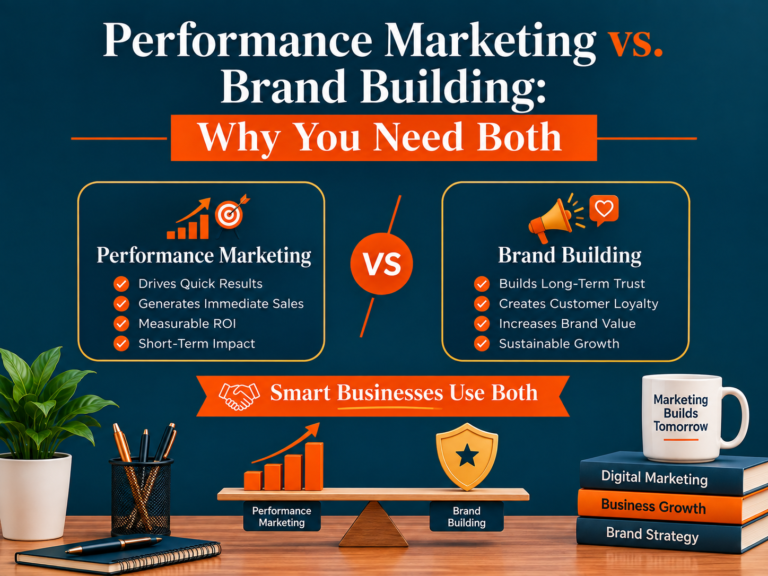
Growth strategy shouldn’t force you to choose between brand building and performance marketing.
They serve different roles.
Performance marketing can help capture demand and generate measurable results.
Brand building can increase recognition, trust, preference, and long-term value.
A business that only focuses on immediate conversions may constantly have to pay for attention.
A business that invests in both can gradually build something more durable.
The strongest growth strategies often combine:
Brand → Demand → Acquisition → Conversion → Retention
Each part supports the next.
What a Strategic Growth Process Looks Like
A practical growth process can be surprisingly simple.
Step 1: Diagnose
Understand what’s currently happening.
Where are customers coming from?
Where are they dropping off?
What’s working?
What’s not?
Step 2: Identify the Biggest Bottleneck
Don’t try to fix everything at once.
Find the problem that is limiting growth the most.
Step 3: Build a Hypothesis
Decide what you believe will improve the situation and why.
Step 4: Execute
Turn the strategy into campaigns, content, offers, landing pages, and processes.
Step 5: Measure
Track meaningful business outcomes.
Step 6: Optimize
Keep what works.
Fix what doesn’t.
Step 7: Scale
Once the system is working consistently, increase investment carefully.
This approach is much more sustainable than constantly chasing the next marketing trend.
How to Know If Your Business Needs More Strategy
You may have a strategy problem if:
- You’re spending more but results aren’t improving.
- Your marketing channels feel disconnected.
- You’re getting leads but they’re poor quality.
- Your sales team complains about the leads.
- Your website gets traffic but few conversions.
- Your ads perform inconsistently.
- You keep changing campaigns without knowing why.
- Your team is producing lots of content without clear goals.
- You can’t clearly explain who your ideal customer is.
- You struggle to explain why customers should choose you.
- Your marketing decisions are mostly based on what competitors are doing.
If several of these sound familiar, the answer may not be “do more marketing.”
It may be time to step back and rethink the system.
The Real Cost of Growth Without Strategy
The most expensive marketing mistake isn’t necessarily spending too much money.
It’s spending money without learning anything useful.
When every campaign has a clear hypothesis, even an unsuccessful campaign can teach you something.
You learn which audience responds.
Which message gets attention.
Which offer converts.
Which objections matter.
Which channel performs.
Which customers are most valuable.
But when campaigns are launched without a strategic foundation, failure often produces nothing except another reason to try something completely different.
That’s how businesses end up in an endless cycle:
Try → Spend → Disappoint → Change Direction → Repeat.
Strategy breaks that cycle.
Final Thoughts
Growth is not created by doing more things.
It’s created by doing the right things in the right order for the right audience with a clear understanding of why they should work.
Before increasing your ad budget, ask whether your strategy is strong enough to support it.
Before creating more content, ask what role that content plays in the customer journey.
Before launching another channel, ask whether your existing channels are working properly.
Before chasing more leads, ask whether you’re generating the right leads.
And before trying to scale, make sure the rest of the business can support the growth you’re asking marketing to create.
Because when strategy is missing, growth can become expensive very quickly.
But when strategy is clear, every marketing activity has a purpose.
You stop chasing growth and start building a system for it.