Most businesses don’t struggle because they aren’t marketing enough.
They struggle because they’re marketing without a clear direction.
One week they’re running Meta Ads. The next week they’re trying Google Ads. Then someone suggests posting more on social media. A few weeks later, they’re redesigning the website because “the leads aren’t good.”
The activity keeps increasing, but the results don’t.
This is one of the most expensive marketing problems a business can have.
A good marketing strategy gives every marketing activity a purpose. It helps you understand who you’re trying to reach, what you want them to do, why they should choose you, where you should reach them, and how you’ll measure whether it’s working.
Whether you’re launching a new business, trying to generate more leads, or struggling to make your existing marketing profitable, you don’t need to start with more advertising.
You need to start with a strategy.
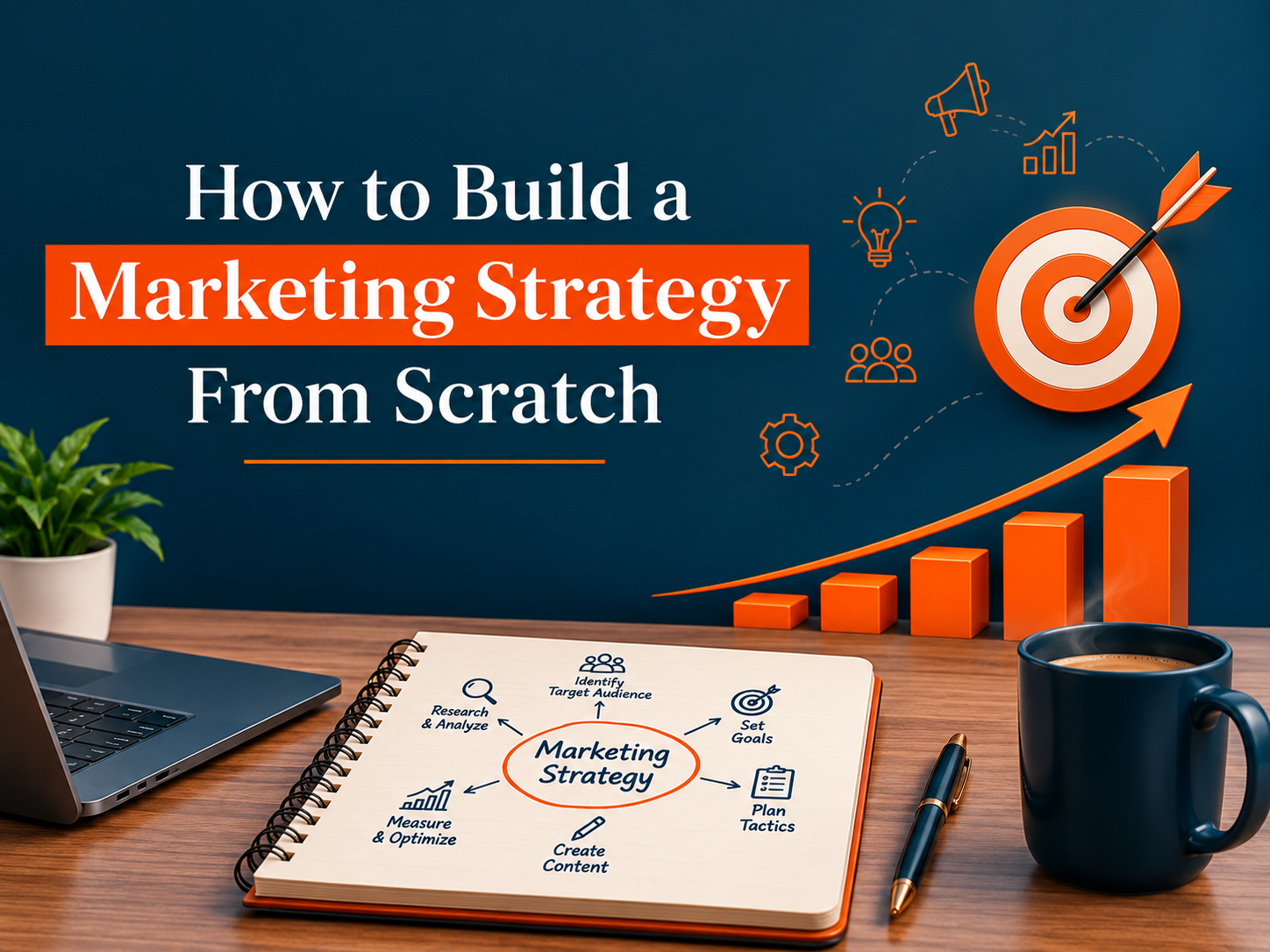
In this guide, I’ll walk through how to build a marketing strategy from scratch, step by step.
What Is a Marketing Strategy?
A marketing strategy is a clear plan for how your business will attract, convert, and retain the right customers.
It connects your:
- Business goals
- Target audience
- Market positioning
- Offer
- Messaging
- Marketing channels
- Content
- Advertising
- Sales process
- Customer experience
- Measurement and optimization
Think of it as the decision-making framework behind your marketing.
Your strategy answers questions such as:
Who are we trying to reach?
What problem are we solving for them?
Why should they choose us instead of another option?
Where can we reach them?
What message will make them pay attention?
What happens after they click or contact us?
How will we know whether our marketing is actually working?
Without these answers, businesses often end up jumping from tactic to tactic.
And that’s where the trouble begins.
Step 1: Start With Your Business Goals
Before thinking about Facebook, Google, Instagram, SEO, or content, start with the business.
What are you actually trying to achieve?
“Get more customers” is a goal, but it’s too vague to build a useful strategy around.
A better goal might be:
- Generate 100 qualified leads per month
- Increase online sales by 30%
- Acquire 500 new customers in six months
- Enter a new market
- Increase repeat purchases
- Build awareness for a new product
- Reduce customer acquisition cost
- Increase average order value
Your marketing strategy should support a specific business outcome.
Why this matters
Imagine a business says:
“We need more website traffic.”
Maybe.
But why?
If the website already gets 20,000 visitors per month and only produces a handful of customers, more traffic may simply create a bigger version of the same problem.
The real issue could be:
- Poor positioning
- Weak messaging
- An unclear offer
- Low trust
- Poor landing page experience
- Weak conversion process
- The wrong audience
Start with the business problem, not the marketing channel.
Step 2: Understand Your Ideal Customer
One of the biggest marketing mistakes businesses make is trying to sell to everyone.
When your message is designed for everyone, it often becomes relevant to no one.
You need a clear picture of your ideal customer.
Don’t stop at basic demographics such as age, gender, or location.
Try to understand:
What do they want?
What outcome are they trying to achieve?
What frustrates them?
What is making their current situation difficult?
What have they already tried?
This tells you what alternatives they’re comparing you against.
What stops them from buying?
Is it price? Trust? Complexity? Lack of information? Timing?
What triggers them to take action?
Understanding buying triggers can dramatically improve your marketing message.
For example, a business selling accounting software shouldn’t simply target “small business owners.”
It could target small business owners who are spending too much time manually managing invoices and are actively looking for a simpler system.
That’s a much more useful audience.
Step 3: Research the Market and Your Competitors
Your customers don’t make decisions in isolation.
They’re comparing you with competitors, alternatives, and sometimes doing nothing at all.
That’s why competitor research should be part of your marketing strategy.
Look at:
- What competitors offer
- How they position themselves
- Their pricing
- Their messaging
- Their website
- Their advertising
- Their content
- Their customer reviews
- Their strengths
- Their weaknesses
But don’t copy them.
The goal isn’t to become a cheaper version of your competitor.
The goal is to discover where you can become more relevant or more valuable.
Customer reviews are particularly useful here.
Look for repeated phrases in positive and negative reviews.
What do customers love?
What do they complain about?
What do they wish was better?
These insights can help you build stronger messaging because you’re using the language customers actually use.
Step 4: Define Your Positioning
Positioning answers a simple but important question:
Why should someone choose your business?
You need to make your value clear.
A weak positioning statement might be:
“We provide high-quality digital marketing services.”
Thousands of businesses can say the same thing.
A stronger position is more specific.
For example:
“We help B2B companies turn paid traffic into qualified sales opportunities through performance-focused marketing systems.”
The second statement gives the audience a clearer idea of:
- Who you serve
- What you do
- What outcome you focus on
Your positioning doesn’t need to sound clever.
It needs to be clear and relevant.
Step 5: Build a Strong Offer
Even excellent marketing can’t permanently rescue a weak offer.
Your offer is more than your product or service.
It includes:
- What you’re selling
- What the customer receives
- The value they get
- Pricing
- Guarantees or risk reduction
- Bonuses or additional value
- How easy it is to buy
- Why they should act now
Ask yourself:
If I were the customer, would this offer feel worth the price and effort?
If the answer isn’t an obvious yes, don’t immediately blame your advertising.
Improve the offer.
For example, instead of selling:
“SEO Services”
you might package the service around a specific business outcome:
“A 90-Day SEO Growth Program for Local Businesses”
The second offer gives the customer more context and makes the service easier to understand.
Step 6: Create Your Core Marketing Message
Once you understand your customer, market, positioning, and offer, you can build your messaging.
Your message should connect what your business does with what your customer actually cares about.
A simple structure is:
Problem → Desired Outcome → Solution → Proof
For example:
Problem:
“Your sales team shouldn’t have to chase unqualified leads.”
Desired outcome:
“Generate a consistent flow of potential customers who are actually interested in what you sell.”
Solution:
“We build and optimize performance marketing campaigns around high-intent audiences.”
Proof:
Then support the claim with testimonials, case studies, data, demonstrations, or other credible evidence.
Good messaging isn’t about using complicated words.
It’s about making the customer think:
“They understand my problem.”
Step 7: Choose the Right Marketing Channels
This is where many businesses start.
It should come later.
Once you know your audience and goals, decide where you can realistically reach them.
Different channels serve different purposes.
Google Ads
Google Ads can be powerful when people are already searching for a solution.
It captures existing demand.
Meta Ads
Meta can be useful for creating demand, reaching specific audiences, testing creative angles, and generating leads or sales.
SEO
SEO can help businesses build long-term organic visibility and capture relevant search demand.
Social Media
Social media can help build awareness, trust, authority, and relationships with potential customers.
Email Marketing
Email can help nurture prospects, increase repeat purchases, and build stronger customer relationships.
Content Marketing
Content can educate prospects, answer objections, build authority, and support both organic and paid acquisition.
The goal isn’t to be everywhere.
The goal is to be where your customers are and where your business can compete effectively.
Step 8: Build Your Customer Journey
Getting someone’s attention is only the beginning.
You need to understand what happens next.
A simple customer journey might look like:
Awareness → Interest → Consideration → Conversion → Retention
For example:
Someone sees your Instagram content.
They visit your website.
They read an article.
They join your email list.
They receive useful information.
They book a consultation.
They become a customer.
You then continue communicating with them after the sale.
Each stage needs a different type of marketing.
Someone who has never heard of you shouldn’t necessarily receive the same message as someone who is ready to buy today.
Step 9: Make Sure Your Website Can Convert
Your website is often the point where marketing money either starts producing results or quietly disappears.
You can have excellent ads, but if your landing page is confusing, visitors won’t convert.
Review your website from the customer’s perspective.
Ask:
- Is it immediately clear what the business does?
- Is the target customer obvious?
- Is the value proposition easy to understand?
- Is there a clear call to action?
- Does the page answer common objections?
- Is there enough proof?
- Is the website mobile-friendly?
- Is the buying or contact process simple?
Your website doesn’t need to win a design award.
It needs to make the next step obvious.
Step 10: Create a Content Strategy
Content shouldn’t exist simply because “we need to post something this week.”
Every piece of content should have a purpose.
Your content can focus on areas such as:
Educational Content
Teach customers something useful.
Problem-Aware Content
Talk about problems your audience is experiencing.
Authority Content
Share your perspective, expertise, frameworks, and insights.
Proof Content
Show results, case studies, testimonials, or examples.
Conversion Content
Explain your offer and encourage people to take the next step.
A strong content strategy doesn’t just generate views.
It helps move people closer to trusting your business.
Step 11: Build Your Advertising Strategy
Once the foundation is ready, paid advertising becomes much more powerful.
Instead of simply saying:
“Let’s run Facebook Ads.”
you can ask:
- Which audience are we targeting?
- What stage of awareness are they in?
- What problem are we addressing?
- What offer are we presenting?
- Which creative angle will we test?
- Where will the traffic go?
- What happens after the lead comes in?
- What metric determines success?
This changes advertising from spending money for attention into a structured acquisition system.
And don’t judge campaigns too quickly.
Marketing data needs context.
A campaign with a high cost per lead isn’t necessarily bad if those leads turn into high-value customers.
Likewise, cheap leads aren’t automatically good leads.
The business outcome matters.
Step 12: Measure What Actually Matters
One of the biggest traps in digital marketing is focusing on vanity metrics.
Likes are nice.
Reach is useful.
Clicks are important.
But businesses ultimately need outcomes.
Depending on your business model, important metrics may include:
- Leads
- Qualified leads
- Conversion rate
- Cost per lead
- Customer acquisition cost
- Revenue
- Return on ad spend
- Customer lifetime value
- Average order value
- Repeat purchase rate
Your marketing dashboard should help you make decisions.
If a metric doesn’t help you understand what to do next, question whether you really need to track it.
Step 13: Test, Learn, and Optimize
A marketing strategy isn’t a document that gets created once and forgotten.
Markets change.
Customers change.
Competitors change.
Platforms change.
Your strategy needs to evolve too.
Test different:
- Audiences
- Offers
- Headlines
- Creatives
- Landing pages
- Calls to action
- Content formats
- Channels
But don’t change everything at once.
If you change five variables simultaneously, you may get a different result without knowing what caused it.
Good optimization is systematic.
Test → Measure → Learn → Improve → Repeat.
Common Marketing Strategy Mistakes
Even businesses with experienced marketing teams can fall into these traps.
Trying to Be Everywhere
Being active on six platforms doesn’t automatically create growth.
Focus your resources where they can have the greatest impact.
Copying Competitors
Your competitor’s strategy may work for their business because of their audience, brand, offer, budget, and market position.
Copying their tactics doesn’t give you their advantages.
Changing Strategies Too Quickly
Marketing takes time to produce useful data.
Constantly changing direction makes it difficult to learn what actually works.
Focusing Only on Acquisition
Getting new customers is important, but don’t forget retention.
Sometimes the easiest growth opportunity is already inside your customer base.
Ignoring the Offer
Businesses often try to improve ads when the real problem is what they’re selling or how it’s packaged.
Measuring the Wrong Things
A campaign can generate thousands of clicks and still produce terrible business results.
Always connect marketing metrics to business outcomes.
A Simple Marketing Strategy Framework
If you’re starting from zero, use this framework:
1. Goal
What business outcome are we trying to achieve?
2. Audience
Who is the ideal customer?
3. Problem
What problem are they trying to solve?
4. Positioning
Why should they choose us?
5. Offer
What exactly are we offering and why is it valuable?
6. Message
What do we need to communicate?
7. Channels
Where can we reach the right people?
8. Journey
What happens from first interaction to purchase?
9. Conversion
What needs to happen to turn interest into action?
10. Measurement
Which numbers tell us whether we’re succeeding?
11. Optimization
What will we test and improve?
This framework is simple, but it prevents one of the most common marketing problems: jumping into execution before knowing what you’re trying to accomplish.
Final Thoughts
Building a marketing strategy from scratch doesn’t mean creating a 50-page document filled with complicated charts and marketing terminology.
A good strategy can be surprisingly simple.
You need to know:
Who you want to reach.
What they need.
Why your business is the right choice.
How you’ll reach them.
What you’ll offer them.
What happens after they respond.
And how you’ll measure the result.
The biggest shift is moving from “What should we post or advertise?” to “What are we trying to achieve, and what is the smartest way to get there?”
That’s when marketing becomes more than a collection of campaigns.
It becomes a growth system.
And once you have that foundation, every ad, piece of content, landing page, email, and marketing decision has a clearer job to do.