If you’re thinking about running paid advertising, there’s a good chance you’ve asked this question:
Should I run Google Ads or Meta Ads?
It’s one of the most common questions businesses ask when deciding where to put their advertising budget.
And the frustrating answer is:
It depends.
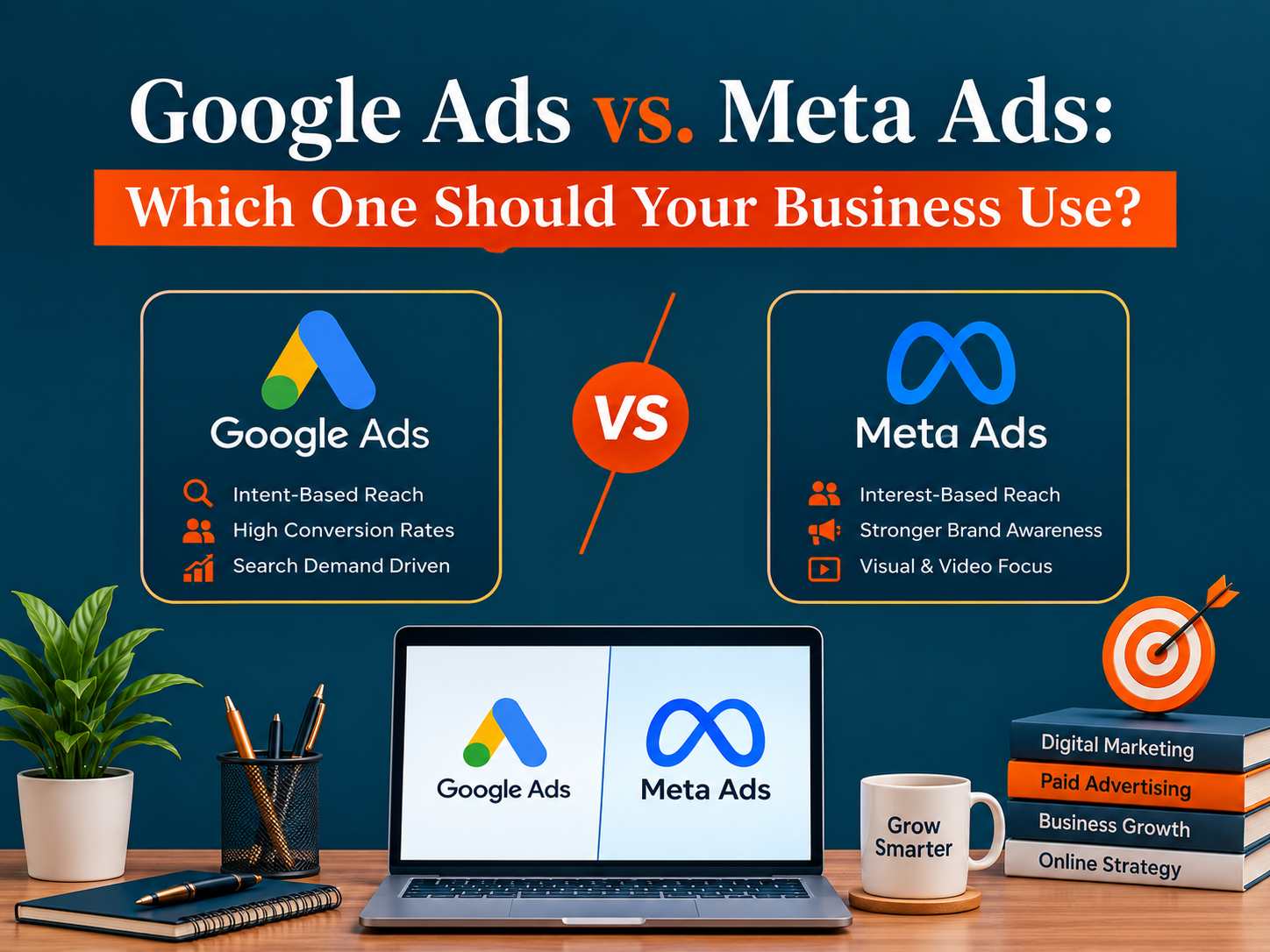
Google Ads and Meta Ads can both generate customers, but they work in very different ways.
Google can help you reach people who are already searching for something you offer.
Meta can help you reach people based on their interests, behaviors, demographics, and online activity, often before they are actively searching for a solution.
Choosing between them isn’t really about deciding which platform is “better.”
It’s about understanding where your customers are in the buying journey and what your business needs right now.
Let’s break it down.
Google Ads vs. Meta Ads: The Basic Difference
At a very simple level:
Google Ads captures existing demand.
Meta Ads can create and stimulate demand.
Imagine someone searches:
“Best dentist near me”
They already have a problem.
They are looking for a solution.
Google gives a dental clinic an opportunity to appear at exactly that moment.
Now imagine someone scrolling through Instagram and seeing a video about a new fitness program.
They weren’t necessarily searching for a fitness program five seconds earlier.
But the creative catches their attention, the offer looks interesting, and they start considering it.
That’s where Meta can be powerful.
Neither approach is inherently better.
They’re simply entering the customer’s journey at different points.
How Google Ads Works
Google Ads allows businesses to advertise across Google’s ecosystem, including search results and other placements.
For many businesses, the most important part is Search Ads.
Someone types a query into Google.
Google determines which ads are eligible to appear.
The business pays when someone clicks, depending on the campaign and bidding model.
The biggest advantage is intent.
Someone searching for:
- “emergency plumber near me”
- “buy running shoes online”
- “best accounting software”
- “digital marketing agency Dubai”
- “wedding photographer Toronto”
is already showing some level of interest.
They may be close to making a decision.
That’s valuable.
The Biggest Advantage of Google Ads: Intent
Google is particularly powerful when people are actively looking for what you sell.
Think about the difference between these two situations.
Person A
Scrolls through Instagram and sees an ad for a project management tool.
They weren’t thinking about project management software.
Person B
Searches Google for:
“best project management software for small teams.”
Person B is much closer to a buying decision.
That’s why Google Search Ads can be extremely effective for businesses with existing search demand.
The platform isn’t necessarily convincing someone that they have a problem.
The person has already raised their hand.
When Google Ads Makes Sense
Google Ads can be a strong choice when:
People Are Already Searching
If customers regularly search for your product or service, Google can put you in front of them at the right moment.
Your Product Solves a Clear Problem
Businesses offering a specific solution often benefit from search intent.
You Need High-Intent Leads
For services such as legal, home services, healthcare, professional services, or B2B solutions, search can capture people actively looking for help.
Local Customers Matter
Local searches can be particularly valuable for businesses such as restaurants, clinics, repair services, salons, contractors, and other local businesses.
You Want Demand Capture
Google is excellent when demand already exists and you want to capture more of it.
But Google Ads Has a Limitation
Google can’t capture demand that doesn’t exist.
This is important.
Imagine you’ve created a completely new product category.
Most people don’t know it exists.
They aren’t searching for it.
You could build a brilliant Google Search campaign, but there may be very little search volume to capture.
That’s where platforms such as Meta can become more useful.
You may need to create awareness before people start searching.
How Meta Ads Works
Meta Ads allows businesses to advertise across platforms such as Facebook and Instagram.
Instead of relying primarily on what someone is searching for right now, Meta can use audience signals to help businesses reach people who are likely to be interested in a product, service, or message.
This makes Meta particularly powerful for discovery and demand generation.
A person might not wake up thinking:
“I need a new skincare brand today.”
But they might see an engaging video, discover a product, visit the website, compare it with alternatives, and eventually buy.
Meta can introduce the product before the customer actively searches for it.
The Biggest Advantage of Meta Ads: Discovery
Meta is built around attention.
People aren’t usually opening Instagram because they need to purchase something immediately.
They’re there to consume content, interact with people, discover ideas, and explore.
That gives businesses an opportunity to interrupt that attention with something genuinely relevant.
For example:
A clothing brand can show a new collection.
A SaaS company can demonstrate a useful feature.
A coach can share a short educational video.
An e-commerce brand can demonstrate a product in use.
A restaurant can showcase a new menu.
The creative becomes a major part of the advertising strategy.
When Meta Ads Makes Sense
Meta can be a strong option when:
Your Product Is Visual
Fashion, beauty, food, fitness, home products, travel, and lifestyle products can benefit heavily from visual creative.
You Need to Build Awareness
If customers don’t know your business exists, Meta can help introduce your brand.
Your Audience Has Clear Characteristics
Meta’s audience signals can help advertisers reach relevant groups.
You Have Strong Creative
Meta performance is heavily influenced by the quality and relevance of your creative.
You’re Selling Products That Can Be Discovered
Some products don’t require people to search for them first.
They can be discovered.
That’s a natural strength of Meta.
Google Ads vs. Meta Ads: The Key Differences
| Google Ads | Meta Ads |
|---|---|
| Primarily captures existing demand | Often creates or stimulates demand |
| Strong search intent | Strong discovery and audience targeting |
| People actively search | People discover while browsing |
| Keywords can be central | Creative and audience signals are important |
| Often effective for high-intent services | Often effective for visual and discovery-driven products |
| Search behavior provides intent signals | User and content signals help with discovery |
| Can work well for local services | Can work well for consumer brands |
| Landing page and offer matter heavily | Creative, offer, and landing page matter heavily |
This isn’t a strict rule.
Both platforms have many campaign types and can be used across different stages of the customer journey.
But the distinction is useful when deciding where to start.
Which Platform Is Better for E-commerce?
This is where things get interesting.
E-commerce businesses can often benefit from both platforms.
Meta can introduce products to new audiences.
Google can capture people who are actively searching for products or brands.
For example:
Someone sees your product on Instagram.
They don’t buy.
Later, they search Google for your brand.
They click your search ad.
They buy.
Which platform generated the sale?
The answer isn’t always as simple as the last click.
The customer journey may involve multiple touchpoints.
That’s why businesses should avoid judging channels in isolation.
Which Platform Is Better for Lead Generation?
Again, it depends.
If someone is actively searching for:
“commercial real estate lawyer near me”
Google can be extremely valuable.
If you’re promoting a service people aren’t actively searching for, Meta can help generate awareness and interest.
For lead generation, don’t just measure the number of leads.
Measure:
Lead quality.
A campaign generating 200 cheap leads isn’t necessarily better than one generating 50 expensive leads if those 50 leads are far more likely to become customers.
What About B2B Businesses?
B2B businesses often assume Google is automatically the answer.
It can be.
But Meta shouldn’t automatically be dismissed either.
A B2B company might use Google to capture people actively searching for a solution while using Meta or other channels to build awareness and stay visible to potential buyers.
The important question is:
How does your buyer actually discover and evaluate solutions?
That’s more useful than asking which platform is popular.
What About Local Businesses?
For many local businesses, Google can be extremely powerful because people often search when they have an immediate need.
Consider:
“AC repair near me”
“dentist near me”
“Italian restaurant downtown”
“car detailing near me”
The intent is obvious.
However, Meta can also be useful for local businesses that want to build awareness, promote offers, showcase their work, or reach people based on local and audience signals.
A local business doesn’t necessarily need to choose only one.
Don’t Choose a Platform Before Understanding the Customer
This is probably the most important point in this entire article.
Don’t start with:
“Should we run Google or Meta?”
Start with:
“How does our customer make a buying decision?”
Ask:
- What problem are they experiencing?
- Do they actively search for a solution?
- How urgent is the problem?
- Do they discover products through social media?
- How long is the buying cycle?
- Is the product easy to understand?
- How much trust is required?
- How much does the product cost?
- Do customers compare several options?
- What information do they need before buying?
Your answers will help determine which channel deserves your attention.
Your Offer Matters More Than Your Platform
There’s another mistake businesses make.
They spend weeks debating Google vs. Meta while ignoring the actual offer.
But neither platform can magically make a weak offer irresistible.
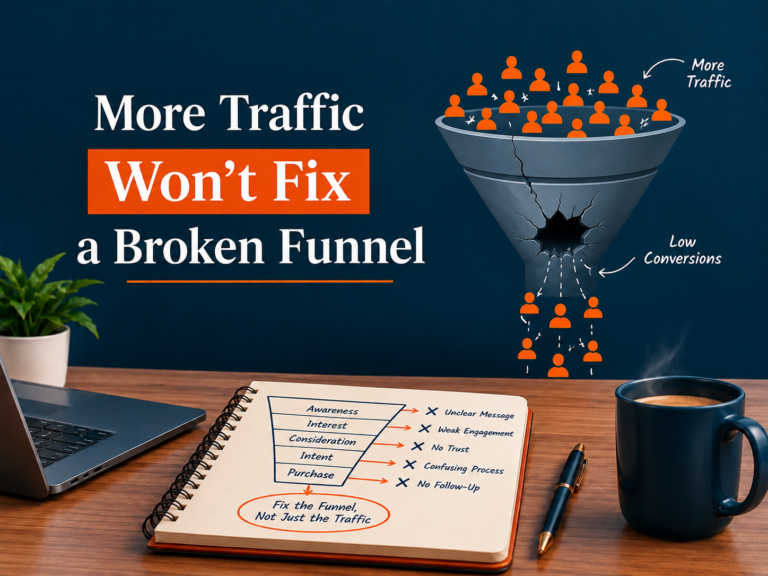
If your product is difficult to understand, expensive without clear value, poorly positioned, or aimed at the wrong audience, switching platforms may not solve the problem.
Before increasing ad spend, ask:
Is the offer strong?
Is the value obvious?
Is the audience right?
Is the message clear?
Is there enough trust?
Does the landing page support the promise?
Advertising amplifies what you already have.
If the foundation is weak, advertising can amplify the weakness too.
Your Creative and Landing Page Matter
A common misconception is:
“The platform isn’t working.”
Sometimes the platform is fine.
The creative isn’t.
Or the landing page isn’t.
Or the offer isn’t.
Or the audience isn’t.
Imagine your Meta ad gets thousands of impressions but very few clicks.
The creative or message may need attention.
Now imagine the ad gets plenty of clicks but almost nobody submits the form.
The landing page or offer may be the problem.
And if you generate lots of leads but few become customers, the problem may be qualification, sales, or lead quality.
This is why performance marketing should be treated as a system, not a single campaign.
Should You Use Google Ads and Meta Ads Together?
For many businesses, yes.
Using both can create a stronger customer acquisition system.
A simple model could look like this:
Meta
Create awareness and introduce the brand.
↓
Website
Educate visitors and build trust.
↓
Capture people who later search for your product or service.
↓
Conversion
Turn high-intent visitors into customers.
↓
Retargeting
Reconnect with people who interacted but didn’t convert.
This isn’t the only way to structure campaigns, but it shows how the platforms can complement each other.
How to Decide Where to Start
If your budget is limited, don’t automatically split it 50/50.
Start with the channel that has the strongest strategic fit.
Start with Google Ads if:
- Customers actively search for your solution.
- Search intent is strong.
- Your product or service solves an immediate problem.
- You have clear high-intent keywords.
- Capturing existing demand is your priority.
Start with Meta Ads if:
- Your product is visually compelling.
- Your audience can be reached effectively through social platforms.
- You need to create awareness.
- Your product can be discovered rather than searched.
- You have strong creative concepts to test.
Consider both if:
- Your customer journey involves multiple touchpoints.
- You have enough budget to test intelligently.
- You want to combine demand generation with demand capture.
- Your business has both awareness and high-intent opportunities.
Don’t Expect Every Campaign to Work Immediately
One of the biggest mistakes businesses make with paid advertising is expecting instant perfection.
Your first campaign isn’t necessarily the final campaign.
You may need to test:
- Audiences
- Keywords
- Search terms
- Ad copy
- Creative
- Offers
- Landing pages
- Calls to action
- Bidding strategies
The objective isn’t simply to launch.
It’s to learn what works and improve it.
That’s the “performance” part of performance marketing.
The Better Question Isn’t Google vs. Meta
The better question is:
Where is the opportunity to create profitable growth?
Sometimes that opportunity is on Google.
Sometimes it’s on Meta.
Sometimes it’s both.
And sometimes the answer isn’t another advertising campaign at all.
It might be:
- A better offer
- Better positioning
- Better creative
- A stronger landing page
- Better conversion tracking
- Better follow-up
- A clearer sales process
- Better customer retention
A strong marketing strategy looks at the whole picture before deciding where to spend money.
Final Thoughts
Google Ads and Meta Ads are both powerful platforms, but they solve different problems.
Google helps you capture people who are already looking.
Meta helps you reach people who may not be looking yet.
The best platform for your business depends on your audience, offer, buying journey, goals, competition, budget, and ability to convert attention into customers.
So before asking:
“Google Ads or Meta Ads?”
ask:
“Where is my customer, what are they thinking about, and what needs to happen before they buy?”
Once you understand that, choosing the right advertising platform becomes much easier.
Because great performance marketing isn’t about finding the platform with the biggest audience.
It’s about finding the right opportunity to connect your business with the right customer at the right moment.