Your website traffic is increasing.
Your ad budget is increasing.
Your impressions look great.
Your analytics dashboard is full of activity.
But sales?
Still disappointing.
So the obvious conclusion is:
“We need more traffic.”
Maybe you do.
But there’s a problem with that assumption.
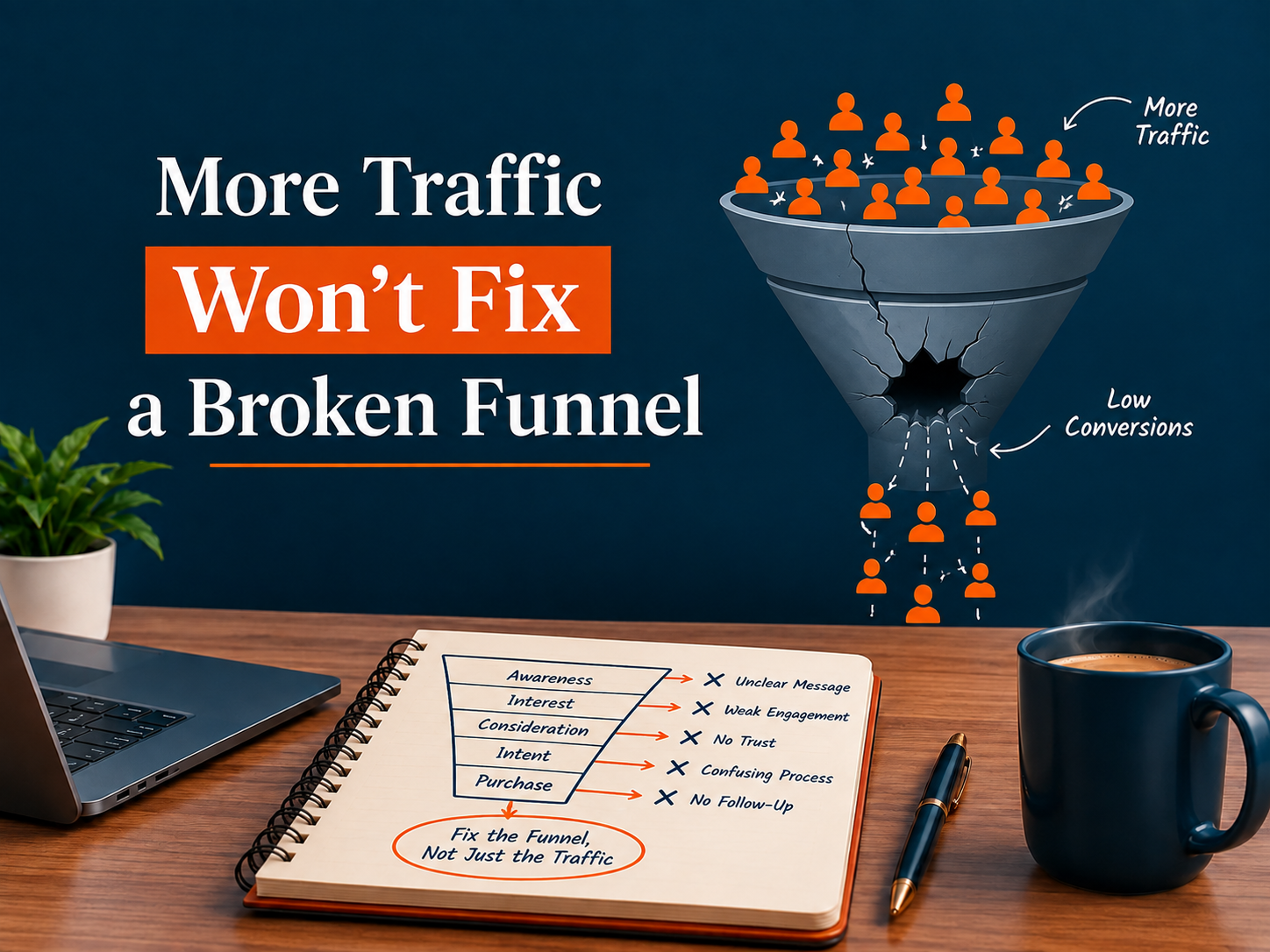
If your funnel is broken, more traffic won’t fix it.
It will simply send more people into the same broken system.
And that can make an already expensive marketing problem even more expensive.
What Is a Marketing Funnel?
A marketing funnel is the journey someone takes from first discovering your business to becoming a customer.
A simple funnel might look like:
Awareness → Interest → Consideration → Conversion → Retention
Someone discovers your brand.
They become interested.
They evaluate your offer.
They decide whether to buy.
Then, ideally, they become a repeat customer.
Every stage matters.
If one stage is weak, it can limit the performance of everything before it.
For example:
Great advertising + poor landing page = poor conversion.
Great website + weak offer = poor sales.
Great offer + poor follow-up = lost customers.
This is why increasing traffic isn’t always the answer.
Sometimes the real opportunity is further down the funnel.
The Traffic Trap
Traffic is easy to focus on because it’s visible.
You can see:
- Website visitors
- Impressions
- Clicks
- Sessions
- Page views
- Cost per click
And when these numbers increase, it feels like marketing is improving.
But traffic isn’t the final goal.
Businesses don’t usually exist to collect visitors.
They exist to create value and generate revenue.
Imagine your website gets:
10,000 visitors → 100 leads → 5 customers
You could spend more money to get:
20,000 visitors → 200 leads → 10 customers
That technically creates growth.
But what if you could improve the funnel instead?
10,000 visitors → 300 leads → 30 customers
You generated the same amount of traffic but created dramatically more business value.
That’s the power of fixing the funnel.
A Broken Funnel Can Hide Behind Good Advertising
This is one of the most frustrating situations for businesses.
Your ads are getting clicks.
The cost per click looks reasonable.
People are visiting your website.
But hardly anyone buys.
The first reaction is often:
“The ads aren’t working.”
But the ads may actually be doing their job.
They generated attention and traffic.
The problem might be what happens after the click.
Maybe the landing page is confusing.
Maybe the offer isn’t clear.
Maybe the page is too slow.
Maybe the visitor doesn’t trust the business.
Maybe there are too many steps.
Maybe the message in the ad doesn’t match the landing page.
Maybe the customer simply isn’t ready to buy.
Before changing the advertising platform, examine the journey.
Step 1: Look at the Traffic You’re Actually Getting
Not all traffic is equal.
You can have thousands of visitors and still have very little commercial value.
Ask:
Are the right people visiting?
If you’re targeting the wrong audience, your conversion rate will naturally suffer.
For example, a luxury service targeting people who are primarily looking for the cheapest option may generate plenty of traffic.
But those visitors aren’t necessarily prospects.
The problem isn’t always the funnel.
Sometimes it’s the traffic quality.
You need both:
The right people + the right journey.
Step 2: Make Your Value Proposition Obvious
When someone lands on your website, they should quickly understand:
What do you offer?
Who is it for?
What problem does it solve?
Why should I care?
If visitors have to scroll through five sections to figure out what you actually do, you have a problem.
Your homepage or landing page shouldn’t make people work unnecessarily hard.
Clarity converts.
Step 3: Check Your Landing Page
Your landing page has one important job:
Move the right visitor toward the next step.
That doesn’t necessarily mean “buy now.”
Depending on your business, the next step might be:
- Request a quote
- Book a call
- Start a free trial
- Add to cart
- Subscribe
- Download something
- Contact the business
- Visit a location
A good landing page should support that action.
Look for unnecessary distractions.
Too many navigation options.
Too much text without structure.
Weak headlines.
Generic stock imagery.
Missing proof.
Unclear calls to action.
Every unnecessary obstacle gives the visitor another reason to leave.
Step 4: Make Sure Your Ad and Landing Page Match
This is a surprisingly common problem.
Imagine your ad says:
“Get 30% Off Your First Order.”
The visitor clicks.
The landing page says:
“Welcome to Our Premium Product Collection.”
Where did the offer go?
The customer has to search for it.
That creates friction.
The experience should feel connected.
If the ad promises a particular solution, the landing page should immediately continue that story.
Think of the journey as one conversation.
Ad → Landing Page → Offer → Conversion
The message shouldn’t suddenly change halfway through.
Step 5: Improve the Offer
Sometimes the funnel isn’t broken.
The offer simply isn’t compelling enough.
Ask yourself:
Why should someone buy this?
Why should they buy it now?
What makes it worth the price?
What risk do they feel?
What would make the decision easier?
You can have an attractive website and excellent advertising, but if the customer doesn’t see enough value, they won’t convert.
Before buying more traffic, make sure you’re giving people a strong reason to act.
Step 6: Build Trust
People don’t buy from businesses they don’t trust.
The amount of trust required varies by product.
Buying a $10 product online is very different from hiring a consultant for a $10,000 project.
The higher the perceived risk, the more reassurance customers usually need.
Your funnel may need:
- Customer reviews
- Testimonials
- Case studies
- Results
- Certifications
- Guarantees
- Clear policies
- Demonstrations
- FAQs
- Transparent pricing
- Real photos
- Information about the team
Trust isn’t something you can force with a button saying:
“BUY NOW!”
It has to be earned throughout the customer journey.
Step 7: Reduce Friction
Every extra step creates an opportunity for someone to leave.
Look at your conversion process.
How many clicks does it take?
How many fields does someone need to fill?
Do they have to create an account before they can understand the offer?
Is the checkout complicated?
Does the page work properly on mobile?
Are there unexpected costs?
Is the call-to-action obvious?
Small amounts of friction can add up.
If you can make the next step easier without sacrificing necessary information, do it.
Step 8: Don’t Ask for Too Much Too Soon
Not every visitor is ready to buy.
This is particularly important for expensive or complex products.
Imagine someone has just discovered your business.
Asking them to immediately schedule a one-hour sales call may be too much.
Instead, you might first offer:
- A useful guide
- A short consultation
- A product demonstration
- Educational content
- A case study
- A free assessment
The right conversion depends on the customer’s level of awareness.
Sometimes the goal isn’t to close the sale immediately.
It’s to move the customer one step closer.
Step 9: Create a Follow-Up System
A funnel doesn’t end when someone leaves your website.
This is where many businesses lose potential customers.
Someone visits.
They don’t buy.
Then nothing happens.
But what if they were genuinely interested and simply weren’t ready that day?
That’s where follow-up matters.
Depending on your business, you could use:
- Email sequences
- Retargeting
- SMS
- Sales calls
- Educational content
- Offers
- Reminders
- Product updates
Not every lead is ready at the same moment.
A strong funnel gives people opportunities to return.
Step 10: Look Beyond the First Conversion
A customer isn’t necessarily the end of the funnel.
It’s the beginning of another relationship.
After someone buys, you should consider:
How do we keep them?
How do we increase satisfaction?
How do we encourage repeat purchases?
How do we turn customers into advocates?
This matters because acquiring an existing customer again can be very different from acquiring a completely new customer.
Retention can become a major part of profitable growth.
Find Your Biggest Funnel Leak
You don’t need to rebuild your entire funnel at once.
Start by finding the biggest leak.
Imagine your funnel looks like this:
50,000 impressions
↓
5,000 clicks
↓
500 landing page visitors
↓
25 leads
↓
2 customers
Where is the biggest problem?
Maybe the ad-to-click rate is fine.
Maybe the landing page is fine.
But only 2 out of 25 leads become customers.
That might point toward:
- Poor lead qualification
- Weak sales follow-up
- Pricing problems
- Poor sales process
- A mismatch between the offer and audience
Don’t automatically optimize the part you understand best.
Optimize the part that’s actually limiting growth.
The Numbers Tell a Story
You don’t need a massive analytics department to diagnose a funnel.
Start with a few basic numbers.
Traffic
How many relevant people are visiting?
Engagement
Are they taking meaningful actions?
Conversion
What percentage becomes a lead or customer?
Cost
How much does it cost to acquire them?
Revenue
How much business does that traffic generate?
Retention
Do customers come back?
These numbers can reveal where your funnel needs attention.
A Simple Funnel Diagnosis
Here’s a practical way to think about it.
Lots of impressions, few clicks
Look at:
Creative + messaging + targeting
Lots of clicks, few landing-page actions
Look at:
Landing page + message match + offer
Lots of leads, few sales
Look at:
Lead quality + sales process + follow-up + offer
Lots of first-time buyers, few repeat buyers
Look at:
Customer experience + retention + product value
This approach helps you avoid blaming the wrong part of the system.
Why More Traffic Can Actually Make Things Worse
Let’s say you’re spending $2,000 per month on advertising.
The funnel isn’t converting well.
You decide to increase the budget to $5,000.
Traffic increases.
But conversion doesn’t improve.
Now you’re losing money faster.
That’s the dangerous part.
More traffic doesn’t just bring more potential customers.
It can also bring:
More unqualified visitors.
More wasted clicks.
More abandoned carts.
More unconverted leads.
More pressure on your sales team.
If the system isn’t ready, scaling can magnify the problem.
Before you pour more water into the bucket, check whether the bucket has a hole.
Traffic and Conversion Work Together
This doesn’t mean traffic is unimportant.
It isn’t.
You need qualified traffic to create opportunities.
But traffic and conversion should be considered together.
Think of it this way:
Traffic creates opportunities.
The funnel turns opportunities into customers.
If you have no traffic, there’s nothing to convert.
If you have traffic but a weak funnel, you’re wasting opportunities.
The goal is to improve both.
What a Healthy Funnel Looks Like
A healthy funnel doesn’t mean every visitor converts.
That’s unrealistic.
Instead, each stage should have a clear purpose.
Awareness
Reach the right people.
Interest
Give them a reason to continue.
Consideration
Answer their questions and build confidence.
Conversion
Make taking action easy.
Retention
Deliver enough value that they want to stay.
Advocacy
Give satisfied customers reasons to recommend you.
This creates a system rather than a one-time transaction.
Before You Increase Your Ad Budget, Ask These Questions
Before spending more money on advertising, ask:
Are we targeting the right people?
Is our offer strong enough?
Is our positioning clear?
Does our landing page match our ad?
Can visitors understand the value quickly?
Do we have enough trust signals?
Is the conversion process simple?
Are we following up with leads?
Are we measuring qualified leads rather than just leads?
Do we know our customer acquisition cost?
Are customers coming back?
If you don’t know the answers, increasing your budget may be premature.
The Best Growth Opportunity Might Already Be in Your Funnel
Sometimes the easiest growth isn’t finding more people.
It’s getting more value from the people you already reach.
Imagine you currently have:
10,000 visitors
and a
1% conversion rate.
That’s 100 conversions.
If you improve the conversion rate to:
2%
you now have 200 conversions from the same amount of traffic.
No additional advertising spend.
No additional impressions.
No additional audience.
Just a better system.
That is why conversion optimization deserves as much attention as traffic acquisition.
Final Thoughts
More traffic can help a healthy funnel grow.
But traffic cannot repair a broken one.
If your website isn’t converting, your leads aren’t becoming customers, or your customers aren’t coming back, the answer may not be another advertising campaign.
It may be time to step back and examine the entire customer journey.
Look at the audience.
Look at the message.
Look at the offer.
Look at the landing page.
Look at the conversion process.
Look at the sales follow-up.
Look at retention.
Then find the biggest bottleneck and fix that first.
Because sustainable growth isn’t simply about getting more people through the door.
It’s about building a system that gives the right people a compelling reason to stay, trust, buy, and come back.
More traffic can fill a funnel.
Only a strong funnel can turn that traffic into growth.