
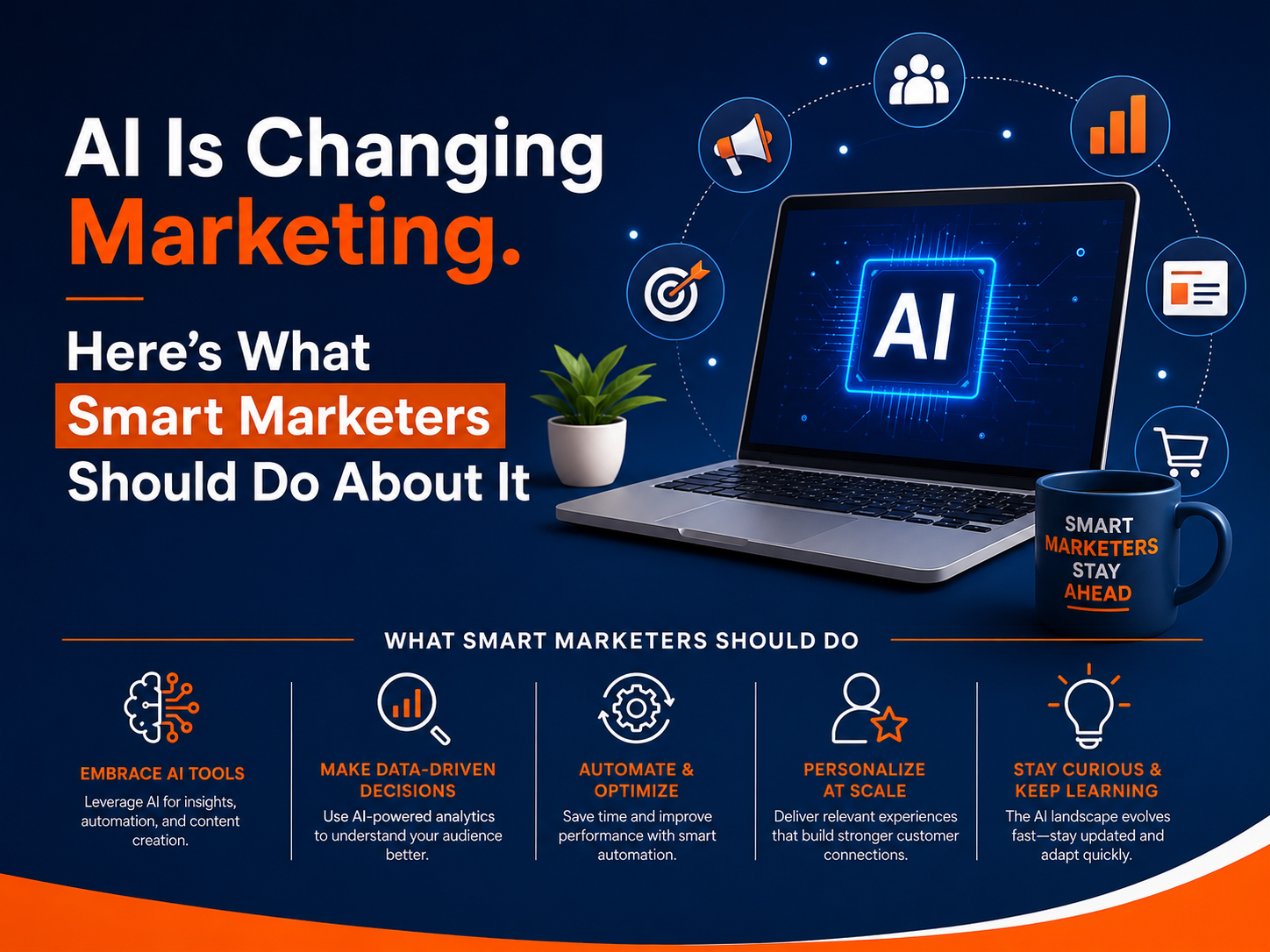
Artificial intelligence has moved from being an interesting technology to becoming part of everyday marketing.
AI can help write copy, analyze data, generate ideas, research audiences, create images, summarize information, automate repetitive tasks, and even help marketers make decisions.
And that’s creating a lot of excitement.
But it’s also creating anxiety.
Many marketers are asking:
Will AI replace marketers?
Business owners are asking:
How can I use AI to reduce costs and get better results?
And some marketers are simply wondering:
Where do I even start?
The answer isn’t to become obsessed with every new AI tool that appears.
The smarter approach is to understand how AI is changing marketing and where it can actually create an advantage.
Because AI isn’t removing the need for marketing expertise.
It’s changing what that expertise looks like.
AI Isn’t Just Another Marketing Tool
Marketing has always evolved with technology.
Search engines changed how people discover businesses.
Social media changed how brands communicate.
Marketing automation changed how businesses nurture leads.
Analytics changed how marketers measure performance.
AI is different because it can influence almost every part of the marketing process.
It can help with research.
It can help with strategy.
It can help with content.
It can help with creative development.
It can help with analysis.
It can help with automation.
It can even help marketers work through problems that previously required hours of manual effort.
That means the competitive advantage won’t necessarily come from simply using AI.
Almost everyone will have access to AI.
The advantage will come from knowing how to use it well.
The Biggest Mistake Marketers Can Make With AI
The easiest way to use AI is also one of the least valuable:
Generate something. Copy it. Publish it. Move on.
You ask AI to write ten social media posts.
It gives you ten posts.
You ask it for five ad headlines.
It gives you five headlines.
You ask it to write a blog.
It writes a blog.
The problem?
Your competitors can do exactly the same thing.
If everyone uses AI to produce generic content, generic content becomes even less valuable.
The real opportunity is not:
“How much content can AI produce?”
It’s:
“How can AI help me think, learn, create, and execute better?”
That’s a much more powerful question.
AI Can Make Good Marketers More Productive
One of the clearest benefits of AI is speed.
Tasks that once took hours can sometimes be completed much faster.
For example, a marketer might use AI to help:
- Summarize customer research
- Organize ideas
- Analyze campaign data
- Generate content variations
- Research competitors
- Develop creative concepts
- Create campaign briefs
- Repurpose content
- Draft reports
- Identify patterns
- Automate repetitive workflows
This doesn’t mean the marketer becomes unnecessary.
It means the marketer can spend less time on repetitive work and more time on judgment, strategy, and decision-making.
That’s an important distinction.
Use AI for the First Draft, Not the Final Thought
One of the most useful ways to think about AI is as a starting point.
AI can give you:
- A first draft
- A list of ideas
- Different angles
- Questions you haven’t considered
- Possible structures
- Variations to test
- A starting analysis
But the marketer should still decide:
Is this accurate?
Is this relevant?
Does this sound like the brand?
Would a real customer care about this?
Is there evidence behind the claim?
Does this actually support the business goal?
AI can accelerate thinking.
It shouldn’t eliminate thinking.
AI Is Changing Content Marketing
Content creation is one of the areas where AI has had the most visible impact.
A single marketer can now generate ideas, outlines, drafts, variations, summaries, and repurposed content much faster than before.
But this creates a new problem.
The internet is becoming crowded with average content.
If producing a 1,000-word article becomes easier, producing a 1,000-word article is no longer a major competitive advantage.
The advantage shifts toward:
- Original insights
- First-hand experience
- Strong opinions
- Useful frameworks
- Unique examples
- Customer understanding
- Better storytelling
- Clear positioning
- Genuine expertise
AI can help you package knowledge.
It can’t magically give you meaningful knowledge to package.
The New Content Advantage: Experience
Imagine two articles about Google Ads.
One is generated from publicly available information.
The other is written by someone who has actually managed campaigns, made mistakes, analyzed performance, tested creatives, and worked with real businesses.
Which one would you rather read?
The second one.
Because experience creates something AI-generated summaries often lack:
context.
This is why marketers shouldn’t try to compete with AI by producing more generic information.
Instead, they should bring something AI can’t easily manufacture:
their own perspective and experience.
AI Can Help You Understand Customers Better
Customer research is another area where AI can become extremely useful.
Businesses collect huge amounts of customer information:
- Reviews
- Survey responses
- Support conversations
- Sales calls
- Comments
- Emails
- Search queries
- Product feedback
The problem isn’t always a lack of information.
It’s the time required to make sense of it.
AI can help organize and analyze large amounts of customer language.
For example, you might ask AI to identify:
- Common customer complaints
- Frequently mentioned benefits
- Buying objections
- Reasons people choose your product
- Reasons people don’t buy
- Repeated phrases customers use
- Common problems
- Differences between customer segments
These insights can influence your marketing strategy.
Your ads become more relevant.
Your landing pages become clearer.
Your content addresses real problems.
Your offers become easier to communicate.
That’s a much more valuable use of AI than simply asking it to “write a Facebook ad.”
AI Can Improve Advertising Workflows
Performance marketers can use AI across different parts of the advertising process.
For example:
Research
Analyze audiences, competitors, market information, and customer language.
Creative Development
Generate concepts, hooks, angles, scripts, and variations.
Copywriting
Create different versions of headlines, primary text, calls to action, and offers.
Analysis
Help identify patterns in campaign data and highlight areas worth investigating.
Testing
Develop multiple hypotheses for creative, audience, messaging, or landing page experiments.
Reporting
Turn complex campaign information into easier-to-understand summaries.
But there’s an important rule:
AI should help you make better decisions, not make decisions blindly.
A marketer still needs to understand the numbers.
If AI tells you that a campaign is underperforming, you need to understand why.
Don’t Let AI Make You Lazy With Data
AI can analyze data quickly.
That doesn’t mean you should stop understanding your metrics.
If you’re running performance marketing, you should still understand concepts such as:
- Conversion rate
- Cost per acquisition
- Cost per lead
- Return on ad spend
- Customer acquisition cost
- Click-through rate
- Customer lifetime value
- Average order value
AI can help interpret the numbers.
But you need enough knowledge to recognize when its interpretation doesn’t make sense.
Otherwise, you’re simply outsourcing your judgment.
That’s risky.
AI Is Also Changing SEO
Search behavior is changing.
People increasingly expect quick, useful answers.
Search engines are also evolving how they present information.
This means businesses shouldn’t think about SEO purely as:
“How do I rank for more keywords?”
A stronger question is:
“How do I become a genuinely useful source of information for the people I want to reach?”
AI can help with:
- Topic research
- Content outlines
- Keyword clustering
- Content briefs
- Internal linking ideas
- Content updates
- Competitor analysis
- Search intent analysis
But again, AI-generated content alone isn’t a sustainable SEO strategy.
Useful content still needs:
Experience + expertise + relevance + originality + clarity.
AI Is Changing Brand Building Too
At first, AI might seem more connected to performance marketing than branding.
But that’s changing.
AI can help brands explore:
- Positioning ideas
- Audience segments
- Messaging directions
- Content themes
- Creative concepts
- Brand voice
- Competitive positioning
- Customer perceptions
But brand building still depends heavily on human understanding.
A brand isn’t simply a collection of words and visuals.
It’s the perception people develop over time.
AI can help you communicate more efficiently.
It can’t single-handedly decide what your business should mean to customers.
That requires strategy.
The Human Advantage Is Becoming More Valuable
This may sound strange.
If AI is getting better at producing content and analyzing information, why would human skills become more important?
Because when production becomes easier, judgment becomes more valuable.
When everyone can generate ten ad concepts, choosing the right concept matters more.
When everyone can produce blog posts, having something meaningful to say matters more.
When everyone can generate marketing strategies, knowing which strategy actually fits the business matters more.
When everyone has access to AI, thinking becomes the differentiator.
Five Skills Marketers Should Develop in the AI Era
If you’re a marketer worried about AI, don’t simply collect more AI tools.
Develop skills that become more valuable when AI is everywhere.
1. Strategic Thinking
Learn how to connect marketing activity with business goals.
Understand the customer, market, offer, positioning, and economics.
Tools can help execute a strategy.
They don’t replace the need for one.
2. Customer Psychology
Understand why people buy.
Learn about:
- Motivation
- Friction
- Trust
- Perception
- Objections
- Decision-making
- Customer behavior
The better you understand people, the better you can use AI to communicate with them.
3. Data Literacy
You don’t need to become a data scientist.
But you should understand how to interpret marketing data and connect it to business outcomes.
Don’t just look at clicks.
Look at what happens after the click.
4. Creative Thinking
AI can generate thousands of possibilities.
That makes original ideas more valuable, not less.
Learn how to develop:
- Strong hooks
- Interesting concepts
- Distinctive campaigns
- Better stories
- Memorable messaging
AI can expand your creative options.
You still need to know which options are worth pursuing.
5. AI Fluency
You don’t need to learn every tool.
You need to understand what AI is good at and how it fits into your workflow.
Learn how to use AI for:
Research → Thinking → Creation → Analysis → Automation
The goal is not to become an AI tool collector.
The goal is to become a better marketer with AI.
Don’t Use AI Everywhere Just Because You Can
This is another important lesson.
Automation isn’t always the answer.
Some tasks require human judgment.
Some customer interactions need empathy.
Some brand decisions require nuance.
Some creative work needs a human perspective.
Some strategic decisions depend on information that isn’t easily captured in a prompt.
Ask:
Will AI make this task better, faster, or more scalable?
If yes, use it.
If not, don’t force it.
Technology should serve the strategy.
Not the other way around.
Build an AI-Powered Marketing Workflow
Instead of using AI randomly, create a repeatable workflow.
For example:
Research
Use AI to organize customer insights and market information.
↓
Strategy
Use those insights to identify opportunities and develop hypotheses.
↓
Creation
Use AI to accelerate drafts, concepts, variations, and content production.
↓
Human Review
Check accuracy, originality, brand alignment, and strategic relevance.
↓
Launch
Put the work into the real market.
↓
Measure
Collect actual performance data.
↓
Learn
Use the results to improve your next decision.
This is much more powerful than treating AI as a content generator.
Businesses Should Think About AI as Leverage
For business owners, the biggest opportunity may not be replacing an entire marketing team with AI.
It may be getting more output from the team you already have.
A small marketing team can potentially:
- Research faster
- Create more variations
- Analyze information faster
- Respond to customers more efficiently
- Automate repetitive processes
- Test more ideas
- Personalize communication
- Make better use of existing data
That can create significant leverage.
The question becomes:
How can we use AI to make our marketing team more capable?
That’s a much healthier question than:
How can we eliminate humans from marketing?
The Biggest AI Marketing Mistakes to Avoid
Publishing Generic AI Content
If your audience can tell that your content could have been written for any business, it won’t build much trust.
Trusting AI Without Verification
AI can produce incorrect or outdated information.
Always review important claims and data.
Chasing Every New Tool
A new AI tool isn’t automatically useful just because it is new.
Replacing Strategy With Prompts
A better prompt doesn’t compensate for a weak marketing strategy.
Optimizing for Quantity
Producing 100 pieces of mediocre content isn’t necessarily better than producing 10 genuinely useful pieces.
Losing Your Brand Voice
If AI writes everything, your communication can start sounding like everyone else’s.
Use AI to support your voice, not erase it.
What Should Smart Marketers Do Now?
If you’re a marketer or business owner, you don’t need to panic.
You need to adapt.
Start small.
Identify the repetitive tasks in your workflow.
Find the areas where AI can save time.
Use it to accelerate research and ideation.
Experiment with content workflows.
Use it to analyze information.
Build repeatable systems.
But at the same time, strengthen your strategic and creative skills.
The goal isn’t to compete against AI.
The goal is to become better because of AI.
The Marketer of the Future Won’t Just Be a Marketer
The role is becoming broader.
A strong modern marketer may need to understand:
Strategy + Brand + Performance + Data + Content + AI
You don’t have to become an expert in everything.
But understanding how these pieces connect can give you a major advantage.
The marketer who can look at a business and understand:
“Here’s the problem, here’s the opportunity, here’s the strategy, here’s how we’ll execute it, and here’s how AI can make the system more efficient.”
will be far more valuable than someone who simply knows how to operate a collection of tools.
Final Thoughts
AI is changing marketing.
But the biggest change isn’t that machines can now write ads or create content.
The bigger change is that the cost of producing marketing work is falling.
When production becomes cheaper and faster, businesses need to become better at deciding what is worth producing in the first place.
That’s where strategy becomes more important.
That’s where customer understanding becomes more important.
That’s where creativity becomes more important.
And that’s where human judgment still matters.
Don’t try to beat AI at producing more.
Learn how to use AI to think better, move faster, test more intelligently, and create more value.
The future won’t necessarily belong to marketers who know the most AI tools.
It will belong to marketers who know how to combine technology with good judgment.
And that is a much more interesting future for marketing.